
A dent on a fire extinguisher cylinder is not a scratch on a bumper. It is damage to a pressurized vessel — and once the metal is deformed, the evaluation process changes entirely.
Fire extinguishers in industrial environments take a beating. Mobile equipment vibration, drops, shifting cargo, impacts from tools and materials, and rough transportation all take a toll on equipment that is often mounted and forgotten between inspections.
Not all damage is cosmetic. And the instinct to assume 'it still has pressure, so it's probably fine' is exactly the kind of reasoning that leads to condemned equipment staying in service.
What We Received
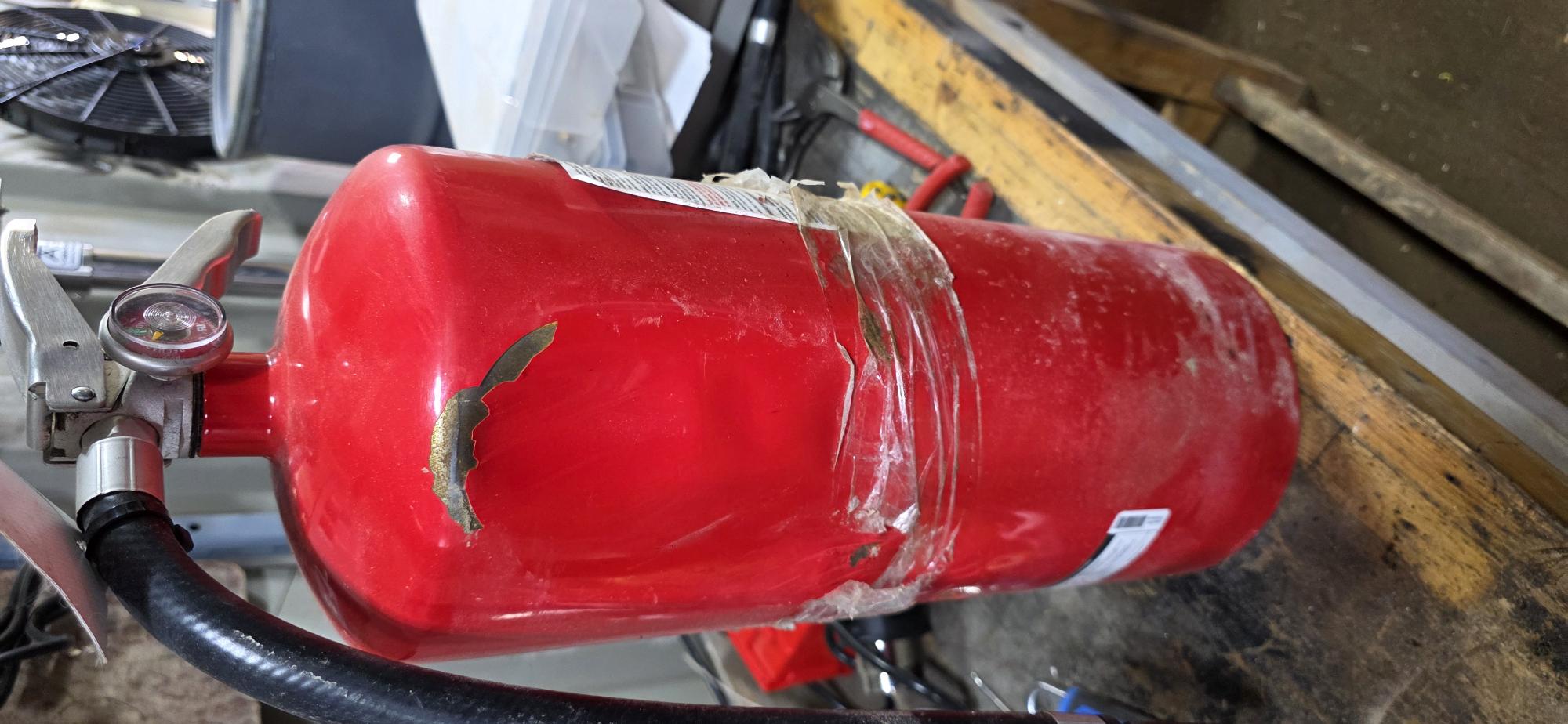
This extinguisher came in with significant impact damage to the upper cylinder body — a deep dent with the paint peeled away and bare metal exposed. Look also at the middle of the cylinder: someone had wrapped tape around the body. Whether that was an attempt to hold something in place, cover additional damage, or simply what accumulated on a unit that had been in rough service for too long, it signals a unit that had not been receiving proper care.
The gauge was in the red — the unit had been previously discharged and never recharged. Dented, taped, and empty. It looked red and cylindrical. It was being treated as ready for service.
Why a Fire Extinguisher Is Not Just a Red Cylinder
A fire extinguisher is a pressurized vessel. That distinction matters because it means the cylinder is under stored pressure energy at all times — not only when it is being used. The structural integrity of the cylinder is what contains that pressure safely between uses, during transportation, during vibration, and during the stress of actual discharge.
When dents, gouges, or deformation occur, several things change:
- Metal thickness may be compromised at the impact point
- Stress concentrations develop around deformed areas — the geometry of a cylinder is load-bearing, and a dent changes that geometry
- Sharp creases in the metal are particularly concerning — a gradual dent is different from a sharp crease that has bent the metal fibres
- Damage near welds, seams, or structural stress points carries additional risk
- Corrosion often develops in damaged areas where the protective coating has been breached, as visible in the exposed bare metal on this unit
The Hydrostatic Testing Question
The standard response to a damaged extinguisher is not to recharge it and return it to service. The question that must be answered first is whether the cylinder can safely withstand hydrostatic testing — and whether it should be condemned rather than tested.
Hydrostatic testing subjects the cylinder to internal water pressure significantly above its working pressure to verify structural integrity. An extinguisher that has deformed under impact may fail that test. An extinguisher that fails hydrostatic testing is condemned — it cannot be repaired and returned to service.
The evaluation questions for a dented unit include: How deep is the deformation? Is the metal creased or smoothly dented? Is damage near a weld or seam? Is there associated corrosion? Has the shape of the cylinder changed permanently? These are not questions that can be answered by looking at the gauge.
The Problem With Mobile Equipment Environments
Truck and equipment extinguishers are especially vulnerable because the conditions that damage them are constant and invisible between inspections. A unit that was in good condition during last year's annual inspection may have been struck by shifting cargo, loosened in its bracket and struck the vehicle frame repeatedly, or dropped during a tire change — none of which generates a report, and all of which can deform a cylinder.
This is why monthly inspections must include a physical examination of the cylinder body, not just a glance at the gauge and a tick on a checklist. A dent that is caught at a monthly inspection is a deficiency that can be evaluated and addressed. A dent that is missed at twelve consecutive monthly inspections is a pressurized vessel failure waiting for a trigger.
What Happens to a Unit Like This
A unit with damage of this severity is removed from service immediately. It is assessed by a certified technician for the depth and character of the deformation, the condition of the metal at the impact site, and whether the cylinder is a candidate for hydrostatic testing or should be condemned outright.
If condemned, the cylinder is destroyed to prevent it from re-entering service. The unit is replaced. The deficiency is documented — because a pattern of damaged equipment on a site is information about mounting practices, transportation conditions, and inspection quality that matters beyond any single unit.
Damaged extinguishers are not just a maintenance issue. They are risk indicators. And a compliance program that tracks them properly can identify those patterns before they become incidents.
Stop Tracking This Manually.
The Inuksuk Compliance Platform tracks every inspection, hydrostatic test, recharge, and deficiency across your entire extinguisher fleet — automatically. Real-time compliance status, technician accountability on every record, and audit-ready reports in 30 seconds. Built by certified field technicians for industrial and multi-site operations.