
Hose bands, mounting brackets, vibration, and weather slowly grind away the one thing that makes a fire extinguisher traceable. Once the serial number is gone, the unit becomes unserviceable — and invisible to your compliance program.
On industrial sites and in mobile equipment environments, fire extinguishers take abuse every day. Vibration, dust, weather, equipment movement, rough transportation, and shifting brackets are facts of life for any unit mounted on a vehicle or in a high-activity field location.
One issue we regularly find during inspections is damage to the extinguisher label and serial number caused by hose retention bands, vehicle mounting brackets, and constant vibration rubbing against the cylinder label. Over time, the bracket or hose holder slowly grinds away the information needed to properly identify and track the extinguisher.
In many cases, serial numbers become unreadable, model information disappears, manufacturing details are lost, and certification markings become damaged. And once that happens, companies lose visibility and traceability of the extinguisher entirely.
What We Find in the Field
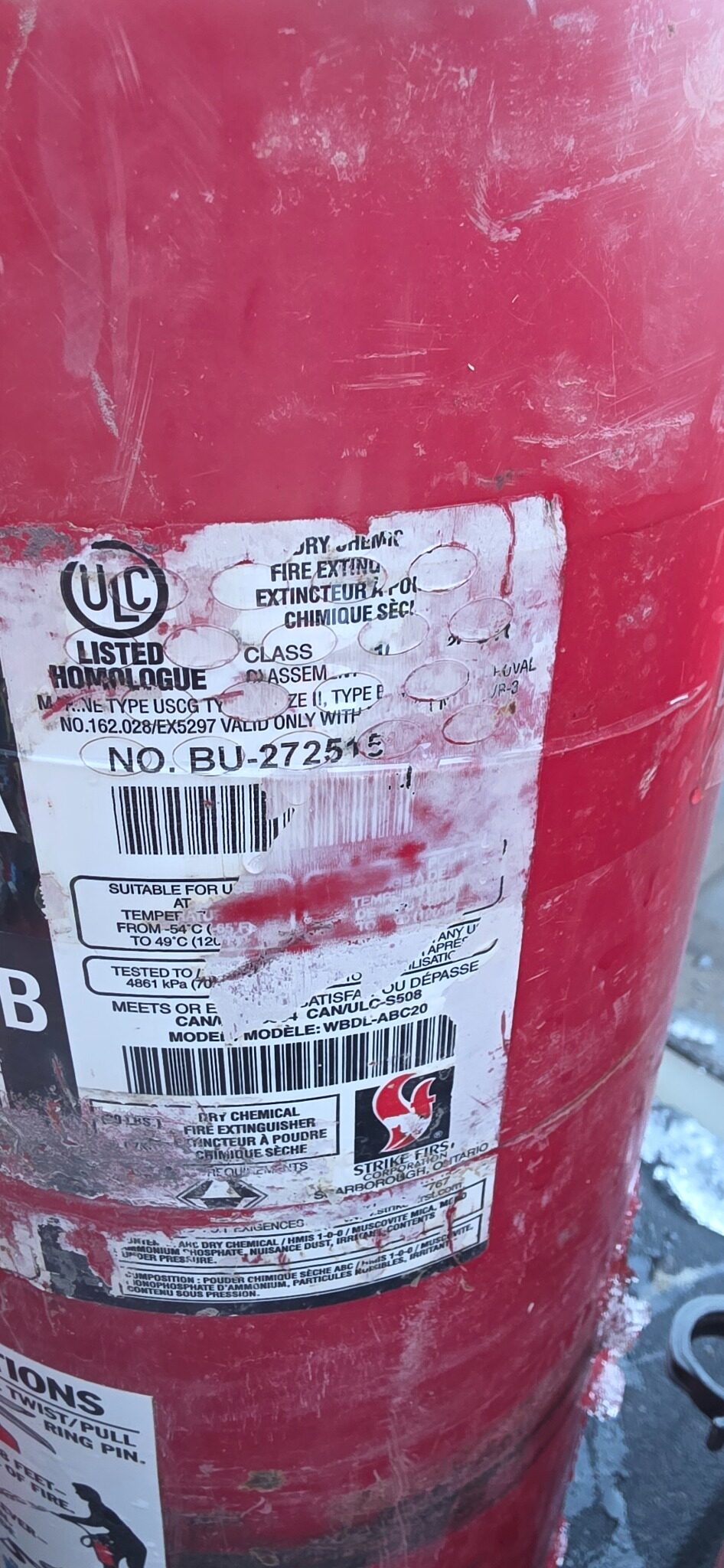
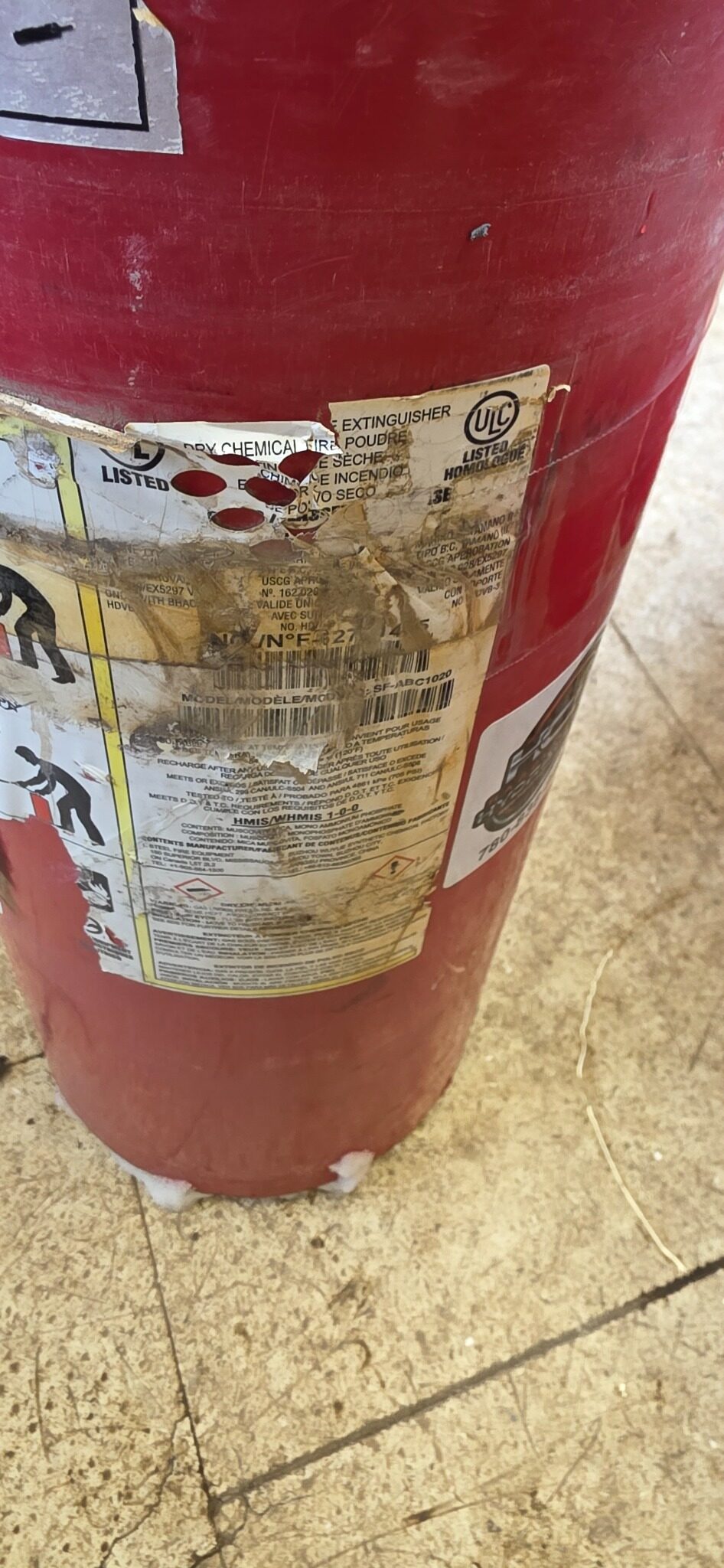
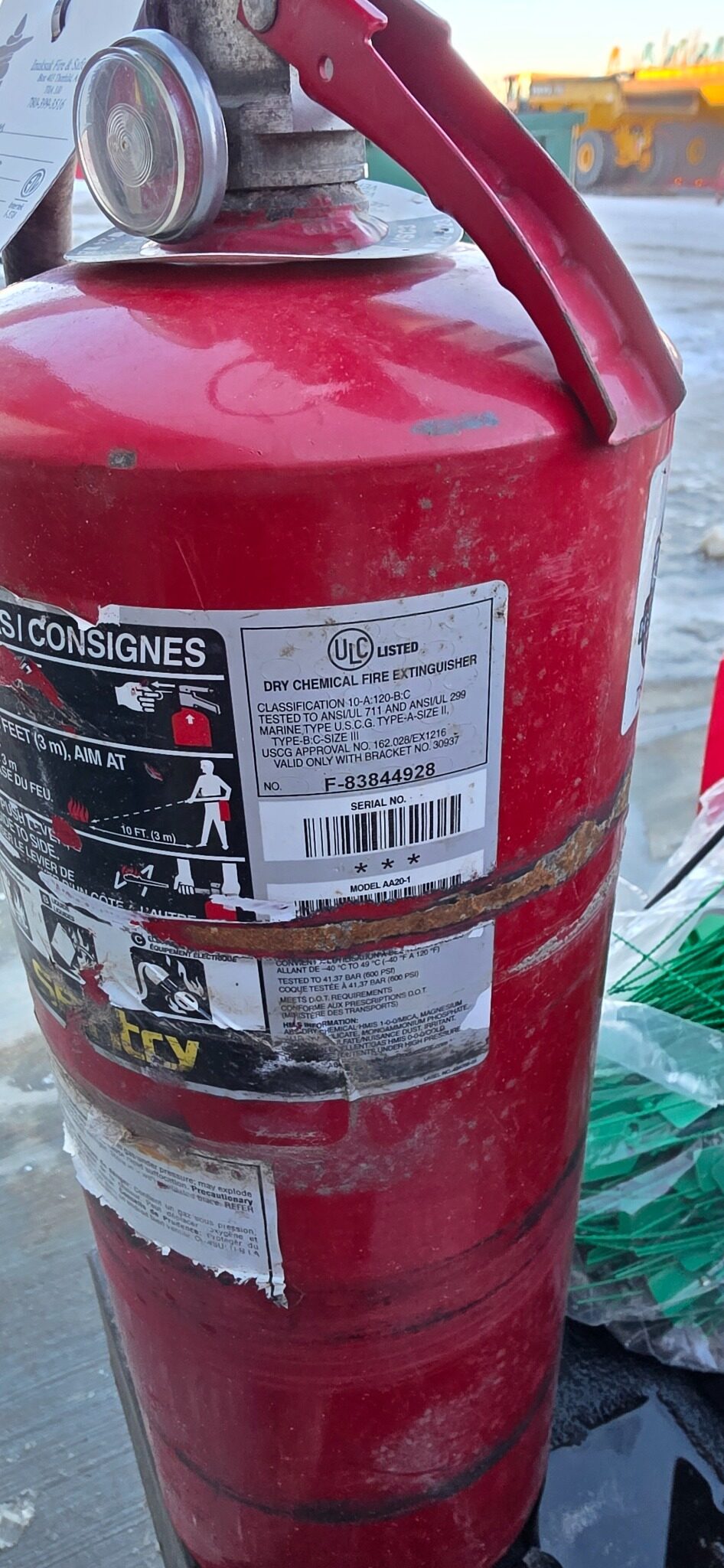
These are not simulated examples. These are photographs taken during real inspections on Northern Alberta industrial sites.
The first image shows label damage typical of a hose band sitting directly over the serial number area. The ULC listing and partial unit number are still visible, but critical identification fields are compromised by red paint transfer and abrasion from constant contact.
The second image shows a more severe case — label peeling, moisture infiltration, and structural deterioration of the identification sticker. The serial number field is barely legible, and the model and classification information is largely destroyed.
The third image is a near-miss. Serial number F-83844928 is still readable — but look at where the hose band damage sits on the label. A few inches higher and that number is gone. The abrasion from the band alone caused this level of label deterioration, and it stopped just short of destroying the one field that makes this unit traceable. This is what band damage looks like before it becomes unserviceable — and most sites never catch it at this stage because no one is looking at label condition during a monthly inspection, only at the gauge and the pin.
Why This Matters for Compliance
An unreadable serial number is not a cosmetic problem. It is a compliance and traceability failure with real operational consequences:
- Inability to verify annual inspection history — without a readable serial, there is no reliable way to confirm which service records belong to which unit
- Hydrostatic test interval tracking fails — NFPA 10 requires hydrostatic testing at intervals based on the cylinder type and manufacture date; without a traceable serial, the interval cannot be reliably calculated
- Manufacturer specifications become unverifiable — without model and classification information, confirming the unit is appropriate for its hazard environment requires physical assessment rather than record review
- Audit exposure — an auditor who cannot read a serial number cannot confirm the unit's compliance history; the unit is effectively undocumented regardless of how good the company's records are
- Duplicate or ghost records in tracking systems — a unit that cannot be positively identified may generate duplicate entries, orphaned records, or simply disappear from the compliance program
- Replacement parts and service kits cannot be confirmed — ordering correct internal components requires model identification that is no longer available from the label
How It Happens — And a Simple Preventative Measure
The damage pattern is consistent: hose retention bands sit directly over the label area, steel brackets make constant contact with the cylinder surface, and vibration does the rest. Add moisture, temperature cycling, and industrial grime, and labels that were readable at last year's inspection may not be readable at this year's.
One simple recommendation we make is applying clear Gorilla Tape or a similar durable clear protective film over serial numbers, manufacturer labels, and critical identification areas before damage occurs. This protects the information from abrasion, moisture, oil, and vibration wear — and costs almost nothing compared to the compliance exposure of an unreadable unit.
Where possible, we also recommend repositioning or removing hose retention bands that sit directly over labels, checking bracket contact points during monthly inspections, and ensuring extinguishers are mounted securely without constant rubbing. The extinguisher itself may still be fully serviceable — but without readable identification, it cannot be properly inspected, tracked, or verified.
How Inuksuk Safety Addresses This
During our annual inspections and field assessments, we document label condition alongside mechanical condition — because a unit with an unreadable serial is a compliance gap even when the pressure gauge reads full and the pull pin is in place.
For units where identification has been compromised, we photograph the damage, document the finding, and advise on replacement or protective measures. For units that are still serviceable, we apply protective covering and flag the unit for enhanced monitoring. For units that can no longer be reliably identified, we recommend retirement and replacement.
Our compliance tracking platform records every unit by serial number and links it to its complete service history — which is exactly why label integrity matters. A unit that loses its serial number loses its record. In a digital tracking system, that means losing the inspection history, the hydrostatic test record, and the compliance documentation that proves due diligence.
Protecting a label is protecting a compliance record. Contact us to discuss label condition assessment as part of your next inspection program.
Stop Tracking This Manually.
The Inuksuk Compliance Platform tracks every inspection, hydrostatic test, recharge, and deficiency across your entire extinguisher fleet — automatically. Real-time compliance status, technician accountability on every record, and audit-ready reports in 30 seconds. Built by certified field technicians for industrial and multi-site operations.