
The wrong extinguisher can make a fire worse. Learn the five fire classes — A, B, C, D, and K — and how to match the extinguisher to the hazard before you act.
Every fire has a class, and the class tells you what is burning. Before using an extinguisher, check the picture symbols and classification on its label. Choosing the wrong agent can fail to put the fire out, damage equipment, or make the situation more dangerous.
This guide is an educational reference for identifying common fire classes. Raise the alarm and call 911 first. Use an extinguisher only on a small, contained fire when you have a clear exit behind you, the correct extinguisher is available, and you are trained and confident to use it. Otherwise, evacuate and stay out.
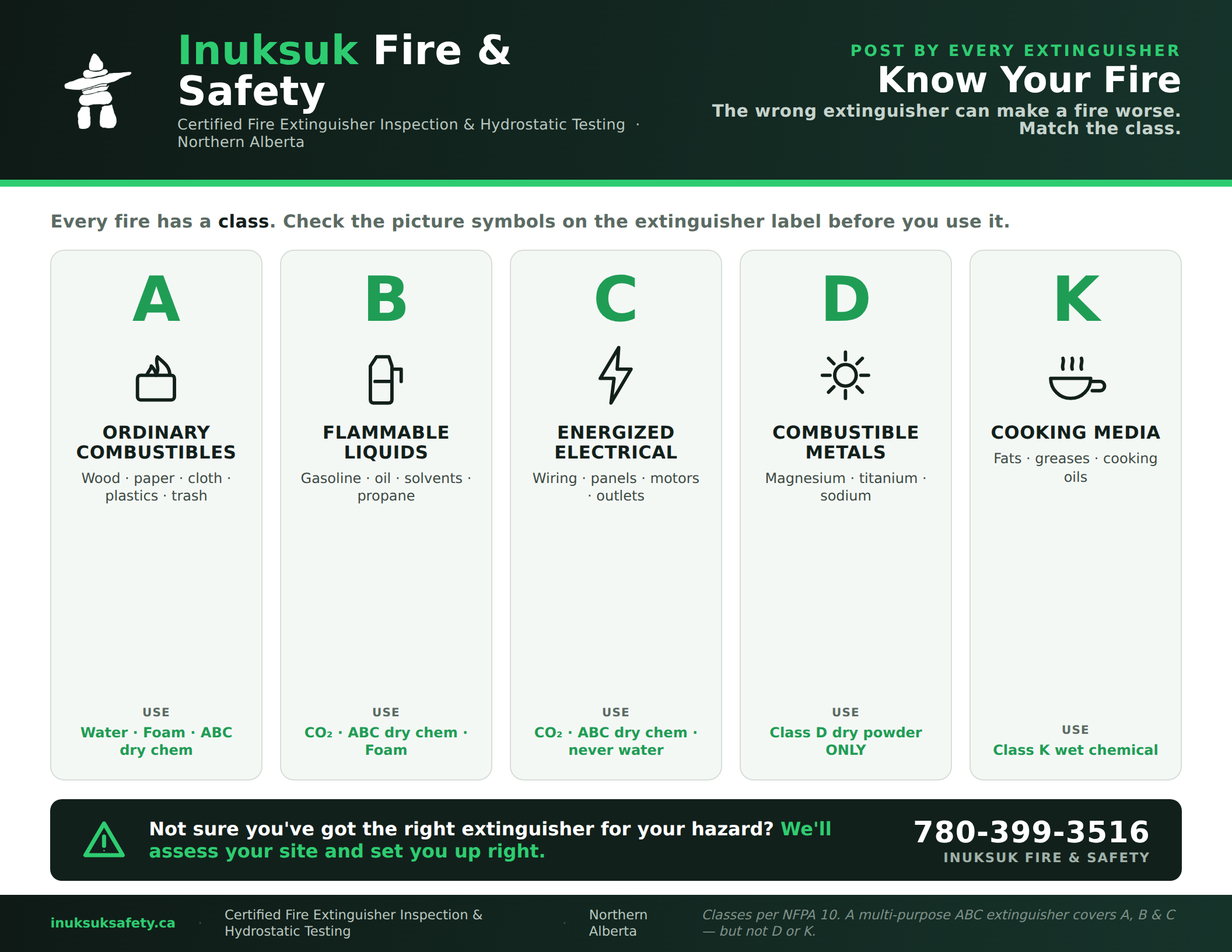
Class A: Ordinary Combustibles
Class A fires involve ordinary combustible materials such as wood, paper, cloth, plastics, and trash. Water, foam, and multipurpose ABC dry chemical extinguishers are commonly used for Class A hazards, depending on the specific application and surrounding risks.
After the visible flames are out, watch for smouldering or re-ignition inside porous materials. Never let an extinguisher's class marking replace a proper assessment of the workplace hazard.
Class B: Flammable Liquids
Class B fires involve flammable liquids and gases such as gasoline, oil, solvents, and propane. Carbon dioxide, ABC dry chemical, and foam extinguishers may be selected for these hazards according to the equipment label and site conditions.
Do not use a method that spreads the burning liquid. Control ignition sources and storage practices before an incident, and make sure flammable-liquid areas have the correct extinguisher type and rating within the required travel distance.
Class C: Energized Electrical Equipment
Class C hazards involve energized electrical wiring, panels, motors, outlets, and similar equipment. Carbon dioxide and ABC dry chemical extinguishers are common choices because they do not introduce water onto energized equipment. Never use water on an energized electrical fire.
If it is safe and authorized to do so, isolate the power source, but do not delay evacuation or put yourself near exposed conductors. Once power is disconnected, the fire may also involve another class of fuel, so reassess the hazard.
Class D: Combustible Metals
Class D fires involve combustible metals such as magnesium, titanium, and sodium. These fires require a compatible Class D dry-powder agent selected for the specific metal. A standard ABC extinguisher is not a substitute for Class D protection.
Metal-fire response requires specialized training and equipment. Do not experiment with water or an unverified extinguisher; evacuate and wait for emergency responders when the fire is beyond your safe capability.
Class K: Cooking Media
Class K fires involve cooking fats, greases, and oils. Commercial cooking appliances require a Class K wet-chemical extinguisher and a properly serviced cooking-suppression system. Never throw water on burning oil, because it can create a violent fireball.
If a small pan fire can be covered safely, turn off the heat and slide a metal lid or baking sheet over it without moving the pan. If the fire spreads or you cannot act safely, evacuate and call 911.
Why ABC Is Not Always Enough
A multipurpose ABC extinguisher covers Class A, B, and C hazards, but it does not cover Class D or Class K fires. A site may need several extinguisher types because hazards differ between offices, workshops, electrical rooms, warehouses, vehicles, and kitchens.
Businesses and fire extinguisher service companies should review extinguisher type, size, rating, placement, accessibility, and service status whenever a process, room layout, or hazard changes. InspectExtinguishers helps organize those units and records across sites and client locations.
Visit InspectExtinguishers at inspectextinguishers.com to start a free trial and keep every extinguisher matched, located, and ready for inspection.
Track extinguisher types, locations, inspections, deficiencies, service history, and testing across your operation.
Affiliate link — we may earn a commission from qualifying purchases
Stop Tracking This Manually.
The Inuksuk Compliance Platform tracks every inspection, hydrostatic test, recharge, and deficiency across your entire extinguisher fleet — automatically. Real-time compliance status, technician accountability on every record, and audit-ready reports in 30 seconds. Built by certified field technicians for industrial and multi-site operations.