Pull the pin, aim, squeeze, sweep. That sequence only works if the pin can actually be pulled. We found one wrapped in multiple winds of steel wire — it took two minutes to untie before we could even begin the inspection.
Pull the pin. Aim. Squeeze. Sweep. The PASS sequence works in an emergency because every step is designed to happen fast, under stress, possibly in smoke, possibly with gloves on. The entire design philosophy of a fire extinguisher assumes that a person in a panic can operate it correctly on the first try.
That assumption breaks down the moment someone wraps the safety pin in steel wire.
What We Found
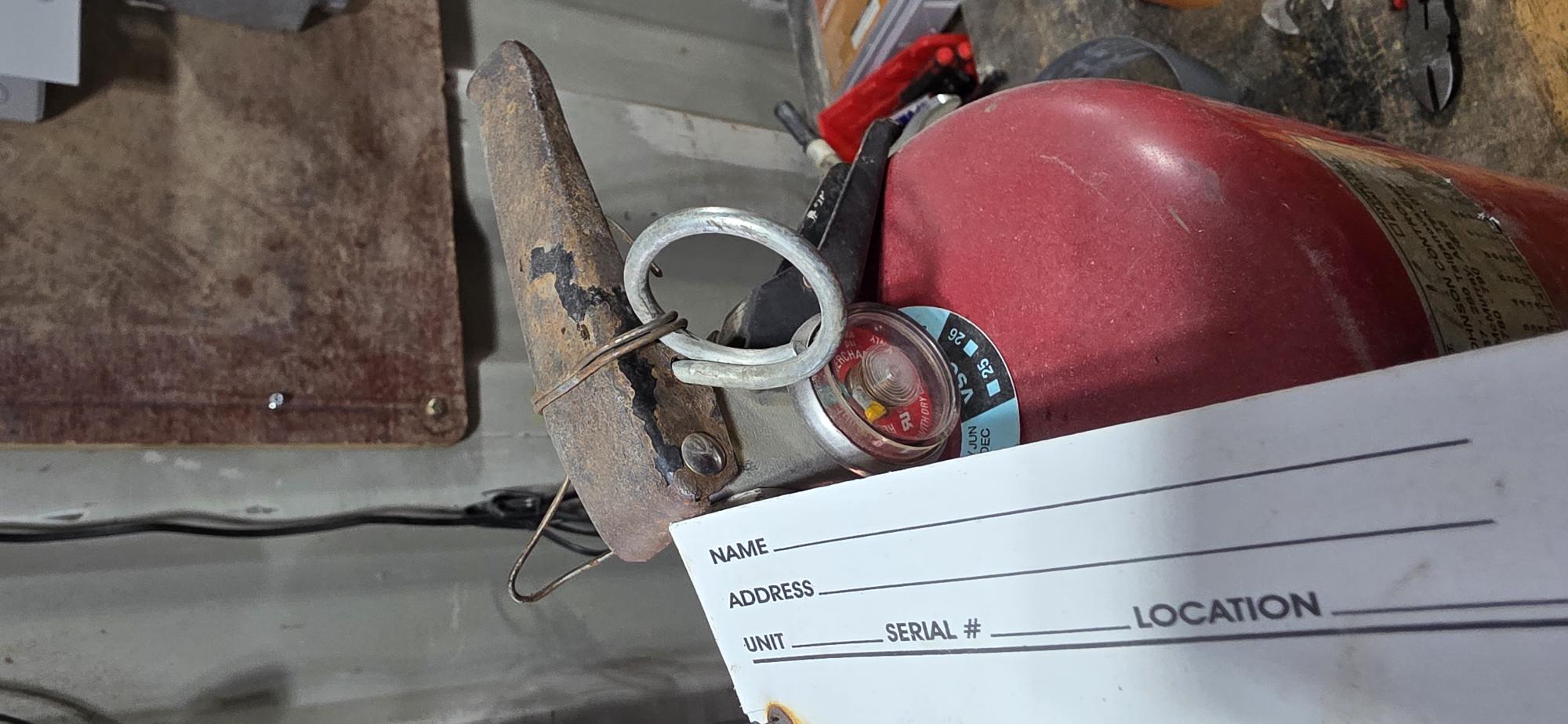
During a recent field inspection in Northern Alberta, we found an extinguisher where the safety pin had been wrapped multiple times with steel mechanic's wire — multiple tight winds holding the pin locked in place. It took nearly two minutes of work to untie it before the pin could even be removed for inspection.
The photo below shows the unit as we found it. Note the heavy rusting on the handle, the industrial service tag hanging from the ring, and the improvised wire restraint. Look also at the pressure gauge — the needle is in the red, indicating the extinguisher had been previously used and was no longer fully charged. This unit was wire-wrapped, discharged, and considered ready for service.
Why the Tamper Seal Exists — And Why It Breaks Away Easily
The tamper seal is a thin plastic or wire loop, and it is intentionally designed to break away with minimal force. That is not a defect. It is the point.
The seal serves two purposes: it indicates whether the extinguisher has been used or tampered with since last inspection, and it keeps the pin seated during normal handling and vibration without requiring any force to remove in an emergency. You pull the ring, the seal breaks, the pin comes out. Done in under a second.
When that seal goes missing — from vibration, rough handling, or mobile equipment movement — it is a deficiency to note and correct at the next inspection. It is not an invitation to improvise a replacement with whatever wire is nearby.
What Happens in an Emergency With a Wire-Wrapped Pin
Consider the scenario: a fire starts at a vehicle, a fuel line, a piece of equipment. The worker grabs the extinguisher. They try to pull the pin. The wire doesn't give. They pull harder. Still nothing. Now they're trying to find the end of the wire wrap, untangling it with gloved hands, in smoke, with adrenaline spiking and fine motor control already degrading.
A fire extinguisher should never require tools, twisting, or untangling before use. Every second of delay is a second the fire grows.
- Emergency response time increases — seconds become minutes
- Gloves make wire removal significantly harder under stress
- Fine motor skills degrade in high-adrenaline situations
- Smoke and heat may already be affecting visibility and breathing
- A worker who can't deploy the extinguisher may abandon it entirely and run
The Correct Fix for a Missing Tamper Seal
Replace it with the proper tamper seal. That is the entire answer. A correct tamper seal is inexpensive, takes seconds to install, and keeps the extinguisher inspection-ready and emergency-ready at the same time. There is no situation in which steel wire, zip ties, mechanics wire, or any improvised restraint is an acceptable substitute.
During inspections, when we find improvised restraints we remove them immediately, document the finding, install a correct seal if available, and flag the unit for follow-up. The goal is always the same: the extinguisher must be capable of being deployed by any worker, immediately, without hesitation.
Small Field Fixes With Large Consequences
This kind of field improvisation usually comes from good intentions — someone noticed the seal was missing, didn't have a replacement on hand, and used what was available to keep the pin from rattling loose. The problem is that the fix creates a worse hazard than the one it was solving.
A missing tamper seal is a minor deficiency. An extinguisher that cannot be rapidly deployed is a serious safety failure. These are not the same level of problem, and they should not be treated the same way.
Program gaps that lead to improvised field fixes — missing inspection accountability, no spare parts on site, no training on what acceptable looks like — are exactly what a structured inspection and compliance program is designed to catch and eliminate before they matter.
Stop Tracking This Manually.
The Inuksuk Compliance Platform tracks every inspection, hydrostatic test, recharge, and deficiency across your entire extinguisher fleet — automatically. Real-time compliance status, technician accountability on every record, and audit-ready reports in 30 seconds. Built by certified field technicians for industrial and multi-site operations.