
If a small fire starts, knowing how to use a fire extinguisher can make the difference between containing it and watching it spread. Learn the P.A.S.S. method — Pull, Aim, Squeeze, Sweep — and the safety checks that come first.
A fire extinguisher is designed for one job: fighting a small, contained fire long enough to keep it from becoming a larger emergency. It is not a substitute for an alarm, an evacuation plan, or a call to 911. Before you pick up an extinguisher, raise the alarm, call 911, and make sure everyone else is moving toward an exit.
If the fire is growing, producing heavy smoke, blocking your exit, or spreading beyond its original source, do not attempt to fight it. Get out, close doors behind you if you can, and stay out. Only use an extinguisher when the fire is small, you have a clear exit behind you, and the room is not filling with smoke.
- The fire is small and contained in a single area.
- The alarm has been raised and 911 has been called.
- A clear exit is behind you at all times.
- The room is not filling with smoke or toxic fumes.
- You have the correct extinguisher for the type of fire.
The P.A.S.S. Method
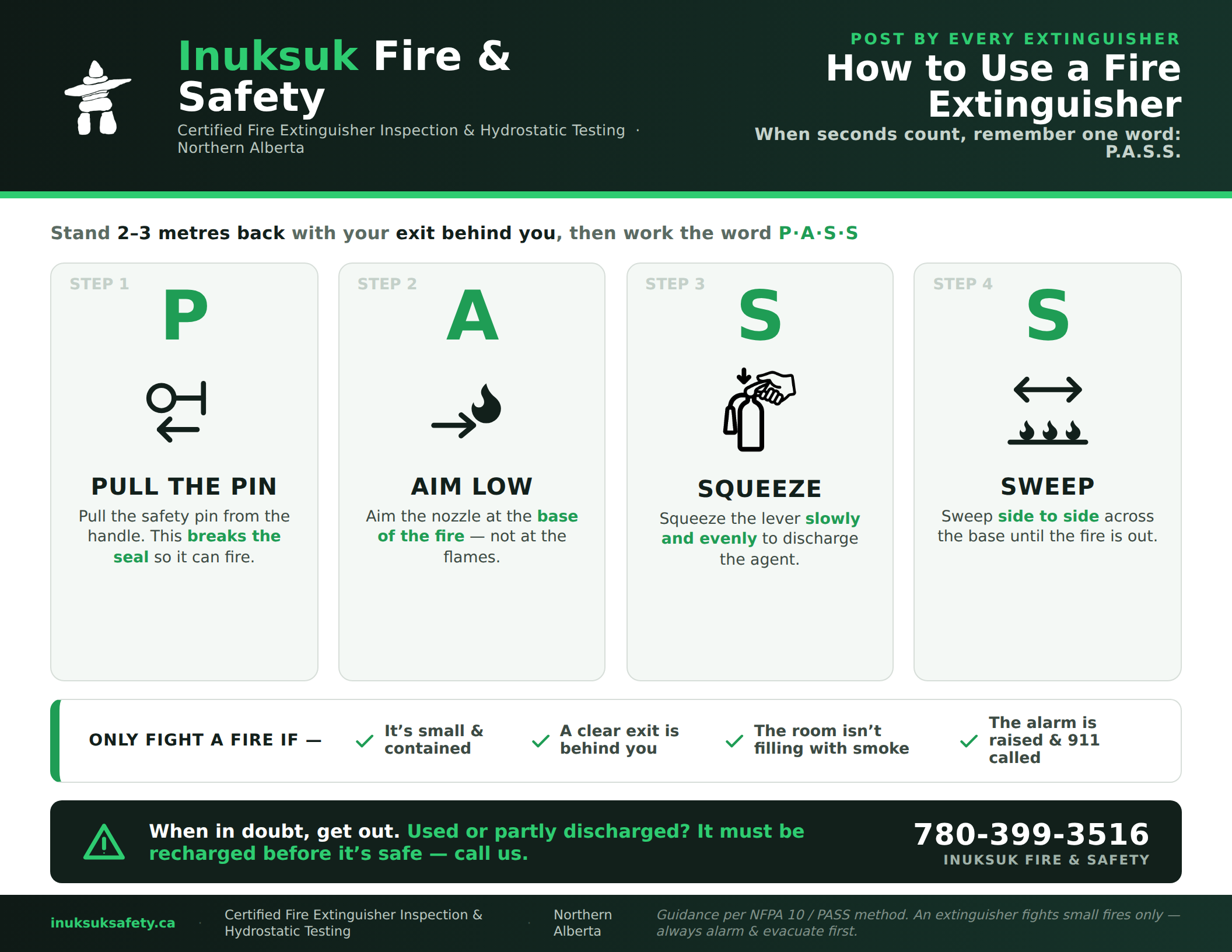
P.A.S.S. is the standard four-step method for operating a portable fire extinguisher. Remember the sequence: Pull, Aim, Squeeze, Sweep. Keep your distance, stay low, and keep watching the fire and your escape route while you work.
1. Pull the Pin
Pull the safety pin from the extinguisher handle. The pin prevents the lever from being squeezed accidentally. Pulling it breaks the tamper seal and prepares the extinguisher to discharge. Keep the nozzle pointed away from yourself and other people while you do this.
2. Aim Low
Aim the nozzle at the base of the fire, where the fuel is burning — not at the top of the flames. Stay two to three metres back to start, then move closer only if the fire is clearly going out.
3. Squeeze the Lever
Squeeze the extinguisher lever slowly and evenly to release the agent. A controlled squeeze gives you a steadier stream and helps conserve the extinguisher's limited capacity. If nothing comes out, stop and leave immediately — the extinguisher may be empty, damaged, or the wrong type.
4. Sweep Side to Side
Sweep the nozzle from side to side across the base of the fire until the flames are out. Continue watching the area for re-ignition. If the fire grows or the extinguisher runs out before the fire is out, evacuate immediately and wait for firefighters.
After the Fire Is Out
Never assume a fire is permanently out just because the flames have disappeared. Watch the area from a safe position and leave if it reignites. A used or partly discharged extinguisher must be removed from service and recharged by a qualified technician before it can be relied on again — even if it appears to still have pressure.
The incident should also be reported to your building manager, safety lead, or emergency coordinator. Record what happened, replace the extinguisher, and review why the fire started so the hazard can be corrected.
Keep Your Extinguishers Ready Before You Need Them
Knowing P.A.S.S. is only useful if the extinguisher is in its designated location, visible, accessible, correctly selected for the hazard, and properly maintained. Businesses should complete documented monthly visual inspections and arrange annual certified service in line with NFPA 10 and applicable fire-code requirements.
For companies with multiple locations or a fleet of extinguishers, digital records make it much easier to know which units are current, which are overdue, and which need service. InspectExtinguishers gives in-house teams and fire extinguisher service companies a simple way to track every unit, inspection, deficiency, recharge, and hydrostatic test in one place.
Visit inspectextinguishers.com to start a free trial and keep your extinguisher program organized.
Fire extinguisher inspection software for businesses and service companies — flat-rate pricing, digital records, and compliance tracking.
Affiliate link — we may earn a commission from qualifying purchases
Stop Tracking This Manually.
The Inuksuk Compliance Platform tracks every inspection, hydrostatic test, recharge, and deficiency across your entire extinguisher fleet — automatically. Real-time compliance status, technician accountability on every record, and audit-ready reports in 30 seconds. Built by certified field technicians for industrial and multi-site operations.